



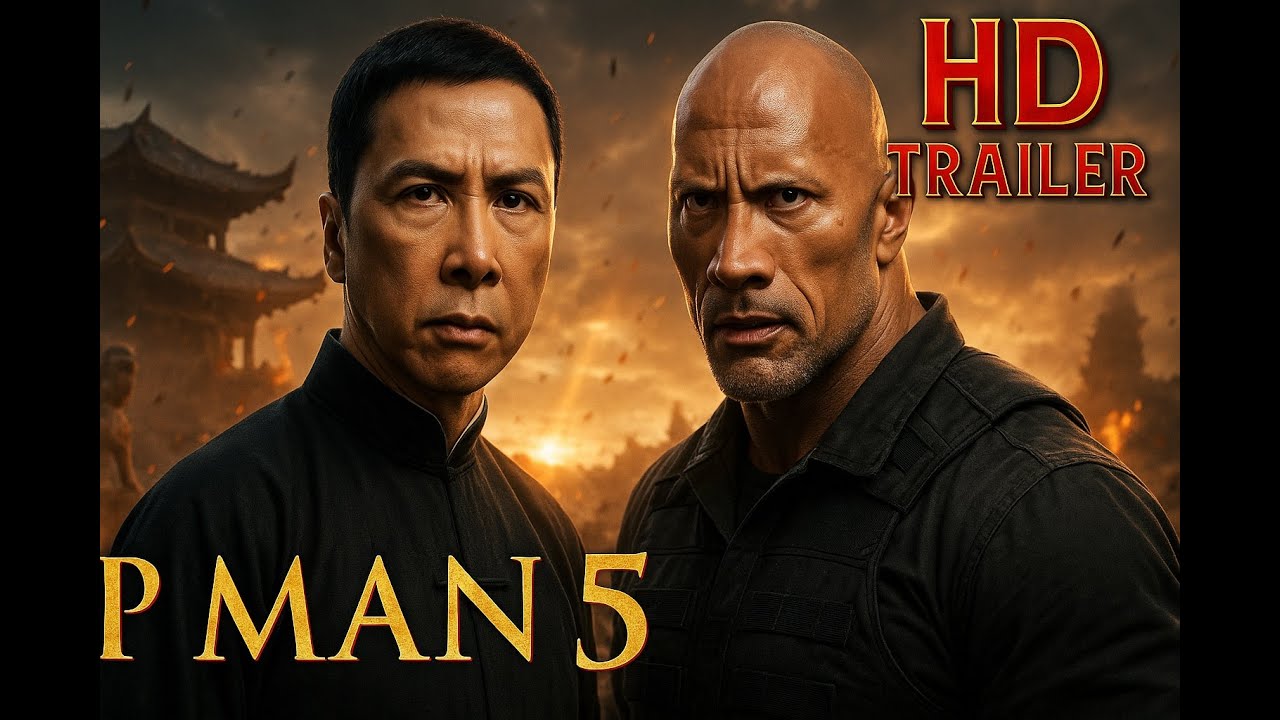
A Legend Returns for One Last Stand
After more than a decade of cinematic storytelling, Ip Man 5 (2026) arrives with the weight of history on its shoulders. This is not merely another sequel extending a profitable franchise; it is a deliberate, reflective farewell to a character who has come to symbolize discipline, humility, and moral clarity in modern martial arts cinema. Watching this film, one feels less like an audience member and more like a student attending a final lesson.

Story Overview: When Tradition Is Put on Trial
The film opens in quiet contemplation. Ip Man, aged and visibly worn by time, believes his journey is complete. His body no longer moves with the effortless grace it once did, but his spirit remains immovable. Just as he prepares to pass on his teachings, a new threat emerges: an international underground fighting syndicate that treats combat as currency and dominance as virtue.

This is not a story about saving the world in a conventional sense. It is about saving the soul of martial arts itself. The syndicate reduces centuries of philosophy into spectacle, stripping away honor and replacing it with brutality. Ip Man steps forward not to prove his strength, but to defend an idea.

Performances That Carry the Weight of Legacy
Donnie Yen as Ip Man
Donnie Yen delivers perhaps his most restrained and mature performance in the series. There is a softness here, a reflective stillness that makes every movement feel earned. Yen understands that this chapter is not about physical dominance, but moral authority. His Ip Man fights less often, but when he does, each strike feels like punctuation in a philosophical argument.
Jackie Chan as Master Lung
Jackie Chan brings warmth, unpredictability, and quiet wisdom as Master Lung, an old rival turned ally. Chan wisely avoids nostalgia-driven excess. Instead, he offers a grounded performance that celebrates adaptability and humility. His chemistry with Yen is understated yet deeply affecting, like two scholars debating life rather than two warriors measuring fists.
Dwayne Johnson as Titan
Dwayne Johnson plays Titan not as a cartoon villain, but as an embodiment of brute ideology. His presence is imposing, his philosophy chillingly simple: power is truth. Johnson uses his physicality effectively, serving as a stark contrast to Ip Man’s economy of movement and inner calm.
Scott Adkins as Kane Black
Scott Adkins may be the film’s most dangerous weapon. As Kane Black, he represents the evolution of modern combat sports: fast, ruthless, and technically devastating. His confrontations with Ip Man are among the most gripping in the franchise, pushing Wing Chun to its conceptual and physical limits.
Action and Choreography: Philosophy in Motion
One of the film’s greatest strengths lies in its commitment to grounded martial arts choreography. CGI is minimal, and the camera respects the performers. Every fight tells a story, not just of who wins, but of why they fight.
- Wing Chun versus modern MMA is framed as an ideological debate
- Fights emphasize timing, balance, and discipline over spectacle
- Each confrontation advances character rather than halting it
The final showdown is less about overwhelming odds and more about enduring belief. It is cinema that understands that action without meaning is noise.
Themes: Honor in an Age of Noise
Ip Man 5 is deeply concerned with what we choose to preserve. In a world obsessed with domination and visibility, the film argues for restraint, respect, and responsibility. Martial arts here are not a method of proving superiority, but a framework for living with dignity.
The central question is simple yet profound: What happens when tradition refuses to bend, and modernity refuses to listen? The film does not offer easy answers, but it insists the conversation matters.
Direction, Tone, and Emotional Resonance
The tone is elegiac without becoming sentimental. The pacing allows moments of silence to breathe, trusting the audience to feel rather than be told. This is a film confident enough to slow down, to reflect, and to let its legacy speak for itself.
As a farewell, it feels honest. As a martial arts film, it feels disciplined. As a statement, it feels necessary.
Final Verdict: A Worthy Farewell
Ip Man 5 (2026) understands that legends do not end with louder explosions, but with quieter truths. It is a respectful, emotionally grounded conclusion that honors both its character and the philosophy he represents. This is not just the final stand of a master, but a reminder of why his teachings mattered in the first place.
Long after the final punch is thrown, the film leaves behind something rarer than adrenaline: reflection.