




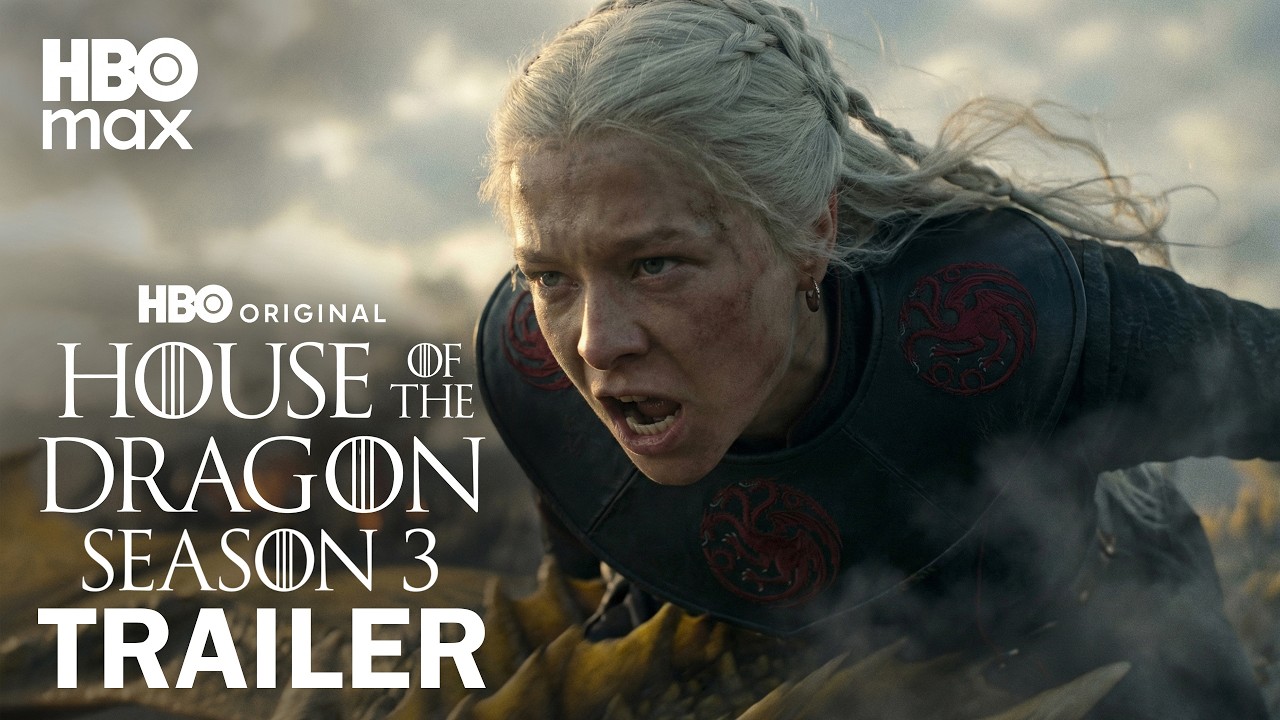
An Empire Consumed by Its Own Flames
By the time House of the Dragon – Season 3 arrives, Westeros is no longer standing on the edge of war—it is fully ablaze. This season plunges headfirst into the most brutal phase of the Dance of the Dragons, a civil war so corrosive that it poisons not only kingdoms, but the very idea of legacy itself. As a longtime viewer of prestige television and a critic who has watched fantasy mature from escapist spectacle into political tragedy, I can say this season represents the series at its most confident and devastating.

Season 3 does not concern itself with easing the audience into chaos. It assumes we understand the cost of ambition by now. Thrones are claimed, lost, and reclaimed, but none of them feel stable. The show’s central question is no longer who deserves to rule, but whether the act of ruling inevitably destroys those who try.

The Escalation of the Dance of the Dragons
The war that once simmered now boils over. What makes Season 3 so gripping is its refusal to frame the conflict as a battle between heroes and villains. Instead, it presents a slow moral erosion, where every faction compromises its principles in the name of survival. Alliances fracture under pressure, oaths are revealed as conveniences, and loyalty becomes a currency spent recklessly.

Each major decision ripples outward with devastating consequences. Victories feel hollow, defeats feel inevitable, and the war itself becomes a living entity—feeding on pride, vengeance, and fear. The writing understands that the true horror of civil war is not its scale, but its intimacy.
Dragons as Weapons, Not Wonders
Once symbols of awe and divine authority, dragons in Season 3 are stripped of their mythic romance. They are weapons of mass destruction, unleashed with a casual cruelty that mirrors humanity’s worst impulses. The show stages its dragon battles with terrifying clarity, emphasizing not spectacle alone, but the collateral damage left behind.
Villages burn, skies darken, and the cost is always paid by those who never chose a side. It is here that the series most clearly echoes real-world history, using fantasy to reflect the brutal logic of unchecked power.
Queens, Princes, and the Corruption of Identity
One of Season 3’s greatest strengths lies in its character arcs. Queens become conquerors not out of ambition alone, but necessity. Princes harden into monsters as idealism is ground down by betrayal and loss. The show excels at portraying transformation not as a sudden turn, but as a series of small, rationalized choices.
No one emerges unscathed. Characters we once sympathized with now commit acts that would have horrified their earlier selves. And yet, the series never abandons empathy. It invites us to understand why these choices are made, even as it condemns their consequences.
Performances That Carry the Weight of History
The cast delivers some of the strongest performances in the franchise’s history. Emotional restraint proves more powerful than grand speeches, and silent moments often speak louder than dragonfire. Grief, paranoia, and resolve are etched into faces that seem to age under the burden of leadership.
This season understands that tragedy is most effective when it feels earned. Characters are not punished for shock value, but for the logical outcomes of their decisions.
Political Drama Sharpened to a Blade
While the battles grow larger, the politics grow darker and more intimate. Council chambers become arenas of manipulation, where words wound more deeply than swords. Season 3 thrives on these quieter confrontations, reminding us that wars are often decided long before armies march.
The dialogue is precise, layered with subtext and historical irony. Promises are made with crossed fingers, and every negotiation feels like a trap waiting to close.
- Complex power struggles with no clear moral center
- Strategic betrayals that reshape the balance of Westeros
- Political decisions that directly fuel the on-screen carnage
Production Scale and Visual Storytelling
From a technical standpoint, Season 3 is a triumph. The production design captures a world collapsing under its own weight, while the cinematography balances grandeur with intimacy. Battle sequences are expansive yet coherent, never losing sight of the human cost amid the chaos.
The score underscores tragedy rather than triumph, reinforcing the sense that history is being written not by heroes, but by survivors.
Final Verdict: A Legacy Forged Through Ruin
House of the Dragon – Season 3 is not merely bigger or darker than what came before—it is wiser. It understands that the true tragedy of the Iron Throne is not who sits upon it, but what it demands in return. Fire will fall, blood will rule, and no one remains innocent.
With a rating of 9.6/10, this season stands as a ferocious continuation that amplifies scale, emotional weight, and thematic depth. It is a reminder that in Westeros, history is not written by the victorious alone, but by the countless lives reduced to ash along the way.